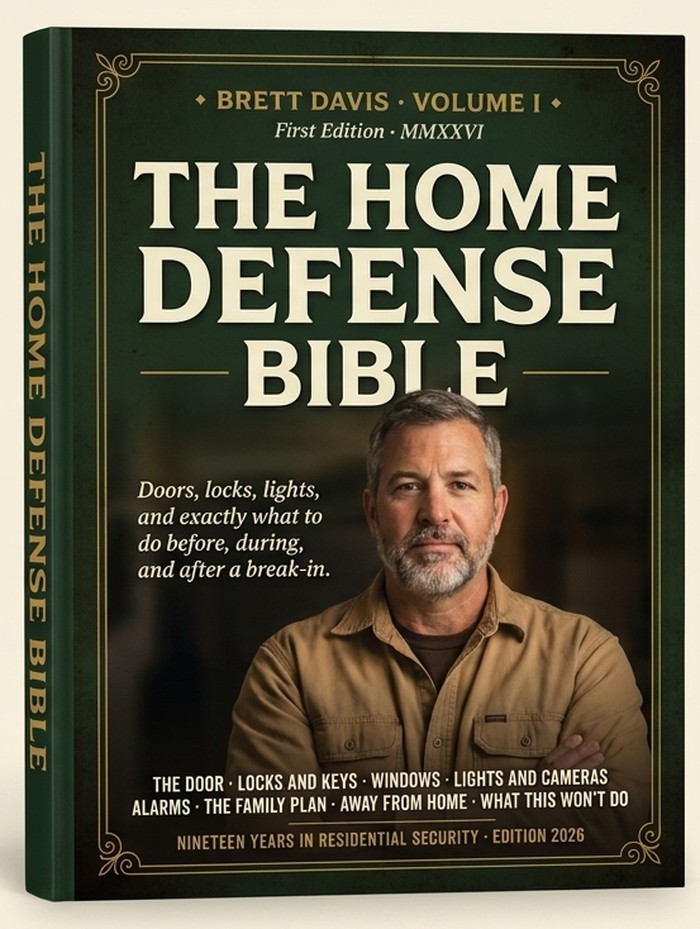
Sixty chapters on doors, locks, lights, cameras and the family plan — what each fix costs, what it buys you, and exactly where it stops working.
Instant download · Yours forever

“You do not need a fortress. You need your house to be a worse choice than the ones around it.”
— Brett Davis
I spent nineteen years in residential security. I started as a locksmith's apprentice doing lockouts and rekeys, moved into alarm and camera installation, and finished doing security assessments for homeowners and small landlords — which mostly meant walking through somebody's house and telling them the truth about it.
I have re-hung more kicked-in doors than I can count, and I have sat at a lot of kitchen tables the morning after with a family that did not sleep.
Every chapter here has a part number, a price, a Saturday afternoon attached to it, or a sentence you can practice out loud at the kitchen table. If a thing does not make your house harder to get into, or does not help you decide faster when it counts, it is not in this book.
And every chapter closes with a section called What This Won't Do — because a security book that only tells you what works is doing you harm.
A hundred-dollar deadbolt in a soft pine frame is a few seconds with a shoulder. The frame is the whole job, and nobody sells you the frame.
Do not try to do all of this at once. Start with Chapter 5 and audit your own house, then Chapter 6 and do the free things — they are worth more than most of what people buy.
The two minutes that decide everything · What a burglar is actually looking for · The four layers: deter, delay, detect, respond · The unlocked door problem · Walk your own house like a stranger · The free fixes and the five dollar fixes
Why doors fail at the frame, not the lock · The strike plate and the three-inch screw · Reinforcing the jamb · Hinges: the half of the door nobody checks · Solid core, hollow core, and knowing what you have · The sliding glass door · French doors, double doors, and sidelights · The garage is your second front door
Deadbolts, grades, and what the numbers mean · Smart locks: what they solve and what they add · Key control: who has a copy of your house · Rekeying in an afternoon · The hide-a-key problem · Padlocks, sheds, and gates
Window locks and pins · Security film: what it does and doesn't · Basement and ground-floor windows · Fences, gates, and the line of the property · Landscaping: sight lines and hiding places · Ladders, bins, and the things that help them climb
What light actually does · Motion lighting done right · The lived-in look · Leaving for a week · What you post and what it tells · Signs, stickers, dogs, and other cheap deterrents
Alarm systems: the honest breakdown · Sensors: doors, windows, motion, glass break · Monitored versus self-monitored · Cameras: placement over megapixels · Doorbell cameras and the front step · False alarms, power cuts, and backup
The knock test · Utility workers, surveys, and distraction · Package theft and deliveries · Phone calls that are really about your house · Never open the door to settle it · Neighbors: the layer money cannot buy
Why you need a plan before you need a plan · The safe room · If you wake to a noise · Making the 911 call · Teaching children without frightening them · Older parents, guests, and people who do not live your routine · Practicing: the ten minute drill
Escape is the plan · What the law actually says about your home · Less-lethal options and their honest limits · If you keep a firearm in the house · Unarmed: distance, doors, and getting out
The first hour after a break-in · Insurance, inventory, and proof · Re-securing and the repeat visit · Sleeping in the house again
Instant download · Yours forever
“I read Chapter 8 on a Saturday morning and had three-inch screws in every strike plate in the house by lunch. Eleven dollars. I had spent four hundred on a lock the year before.”
“The walkthrough in Chapter 5 was the uncomfortable part. Side gate unlatched, ladder against the shed, and a knob lock on the garage door into the kitchen. All of it fixed in a weekend.”
“We ran the ten minute drill with the kids. My nine-year-old knows where to go and what to say on the phone now. That is the part I could not buy at the hardware store.”

Nineteen years in residential security. Locksmith's apprentice first — lockouts and rekeys, mostly — then alarm and camera installation, then the last stretch of it doing security assessments for homeowners and small landlords.
That last part is where this book came from. An assessment is not a sales call. It is walking through somebody's house and telling them the truth about it: this door is fine, that frame is decorative, the money you spent on the front went to the side of the house nobody can see from the street.
I wrote this for everyone who has stood in their own doorway at two in the morning with a flashlight and no plan. This is the plan. Everything before Part Nine is designed so that Part Nine never has to happen — that is the whole point of the book.
Doors, locks, lights, and exactly what to do before, during, and after a break-in.
Instant download · Yours forever
No. It is a working manual. There are no statistics in here designed to keep you up at night. Almost nothing in a break-in is exotic — the house was picked because it looked easy — and nearly all of the fix is hardware, light, sight lines, and one conversation at the kitchen table. Most of this book is a Saturday afternoon and a trip to the hardware store.
The videos are one fix at a time, in whatever order I thought to film them. The book is the whole walkthrough, in the order I would actually do it in your house — audit first, free fixes second, the door your family uses third — with the part numbers, the prices, the time each job takes, and the point at which each fix stops working. That last part does not fit in a video, and it is what keeps you from putting a hundred-dollar lock on a hollow door and calling it done.
Because the whole book argues that the right fixes are cheap and the expensive ones are usually wrong, and I would look ridiculous charging two hundred dollars to say it. $27 is about a box of three-inch screws and a decent strike plate. If the book is worth anything, Chapter 8 pays for it before you finish the morning.
A PDF, delivered the moment you check out. It reads on a phone, a tablet or a computer, and it prints cleanly if you would rather carry the audit sheet around the house with a pencil — which is how I use it. Instant download, yours forever.
A good part of it, yes. The audit, the free fixes, lighting, the lived-in look, answering the door, package theft, neighbors, the family plan and the whole of Part Ten apply whether or not you own the building. Where a fix needs a landlord's permission or a drill, I say so in the chapter and give you the version that does not.
No. Chapter 6 is nothing but the free fixes and the five dollar fixes, and it is worth more than most of what people buy. Three to five minutes of delay is functionally a wall for the ordinary break-in, and in most houses that is two or three hundred dollars and a couple of weekends. Appendix B lays the plan out at several budgets so you can see where your money goes furthest.
Part Nine does, narrowly and carefully. It covers escape as the plan, how to think about the decision before the night it matters, storing things safely, and when to go get real training. It is informational, not legal advice — I am not a lawyer and I am not your instructor. Laws on self-defense, weapons, cameras and recording vary widely by state and change often, so confirm anything in Part Nine with a licensed attorney where you live.
Instant download · Yours forever
People spend four hundred dollars on the wrong hardware every day. $27 gets you the whole walkthrough first — sixty chapters, the audit sheet, and the limit of every fix — so the money goes where it actually buys you seconds.
Get the Home Defense Bible — $47 $27Instant download · Yours forever
or see what's inside →